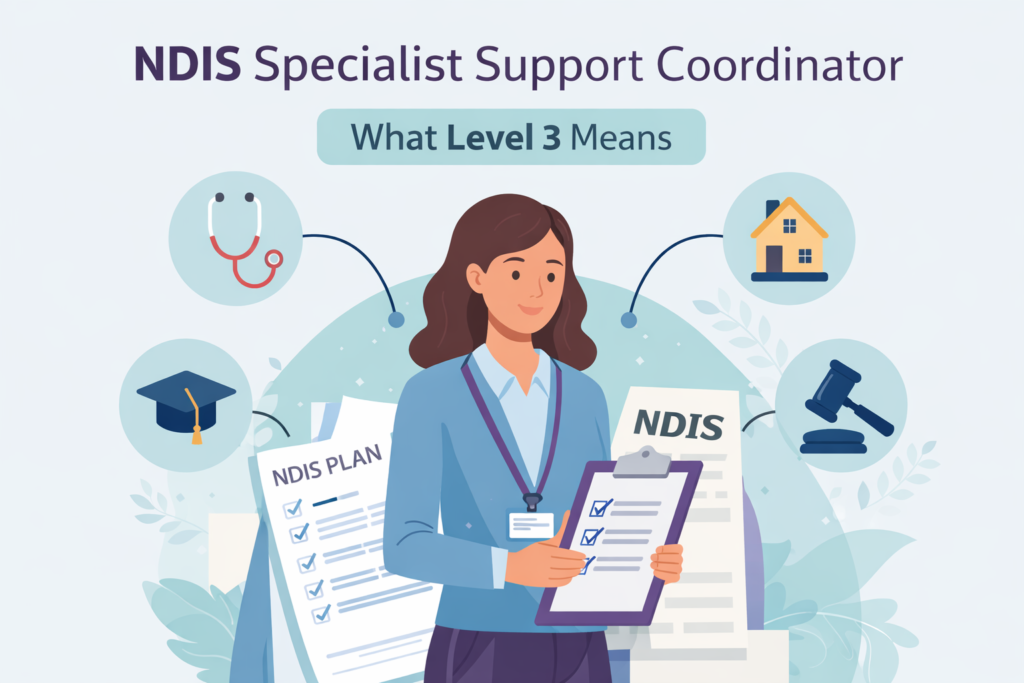
An NDIS specialist support coordinator helps when a participant’s situation is complex and the plan is hard to implement.
A Level 3 support coordinator is also known as a Specialist Support Coordinator. They step in when someone’s NDIS situation is highly complex, and regular coordination isn’t enough to get supports set up, kept running, or made safe and consistent.
In simple terms, Level 3 is for the times when a plan exists on paper, but real life keeps getting in the way.
If you’re unsure which level fits, read our guide on Support Coordination levels, then compare your needs with what an NDIS specialist support coordinator actually does.
NDIS specialist support coordinator vs Level 2: what’s different
Level 2 support coordination usually helps you organise services, connect with providers, and keep supports on track.
However, Level 3 focuses on removing serious barriers that stop the plan from working at all. So, the work is more intensive and often involves higher-risk situations, more conflict, or more moving parts.
In other words: Level 3 isn’t “more hours.” It’s a different level of problem-solving.
What an NDIS specialist support coordinator actually does
A Level 3 support coordinator may:
- Stabilise supports when services keep breaking down or changing
- Coordinate across multiple systems, like housing, health, safeguarding, justice, education, or guardianship issues
- Reduce risk by helping the participant build a workable support setup, especially when safety or wellbeing is involved
- Manage complex provider arrangements so everyone follows the same plan and communication improves
- Help resolve high-conflict situations between providers, families, and services
- Support plan implementation when there are urgent barriers, delays, or repeated service failures
Meanwhile, they still do the normal coordination tasks (calls, meetings, follow-ups). The difference is they do them in situations where things are messy, urgent, or fragile.
When you might need an NDIS specialist support coordinator
Level 3 is commonly used when:
- Multiple providers are involved and communication is failing
- There’s housing instability, homelessness risk, or breakdown of living arrangements
- There are serious safeguarding concerns or high-risk situations
- Behaviours of concern make services hard to maintain consistently
- The participant keeps getting “stuck” and services can’t start despite funding
- There are frequent crises, cancellations, or provider withdrawals
Therefore, if supports keep collapsing and the plan isn’t being implemented properly, Level 3 often fits better than standard coordination.
Real-life examples of an NDIS specialist support coordinator
Here’s how it often plays out:
- A participant has funding and approvals, but no provider will take on the work because the situation is too complex.
- Or supports start, then quickly fall apart due to risk issues, unclear responsibilities, or provider conflict.
- Or everyone is involved—family, support workers, clinicians, housing yet nothing is coordinated, and the participant feels overwhelmed.
In those cases, a Level 3 coordinator can bring structure back, set clear responsibilities, and build stability step by step.
How an NDIS specialist support coordinator is billed
Level 3 is usually billed hourly, and the rate is typically capped under NDIS pricing rules for NDIA-managed and plan-managed participants. However, what matters most is not the hourly rate it’s how the hours get used.
So, always check:
- What the coordinator will claim for (meetings, calls, reports, admin)
- How they explain non-face-to-face time
- How often they update you on hours used and outcomes achieved
What to look for in a good Level 3 support coordinator
A strong Level 3 coordinator usually:
- explains the barriers clearly (not vague words like “complex”)
- shows a plan for stabilising supports, not just “ongoing coordination”
- communicates consistently and documents actions properly
- keeps services aligned and reduces confusion between providers
- escalates issues appropriately when delays or risks appear
In addition, they should help you feel more in control, not more dependent.
Red flags to watch for
Be careful if:
- they can’t explain why Level 3 is needed or what barriers they’re addressing
- invoices are vague with repeated “admin” entries and no detail
- there’s no clear goal for what “success” looks like
- they disappear between crises and only respond when things explode
As a result, your plan budget can drain without the situation improving.
Quick FAQ
Is Level 3 only for certain diagnoses?
No. Level 3 is usually about complexity and barriers, not a specific diagnosis.
Can someone move from Level 2 to Level 3?
Yes. If the situation becomes more complex, planners may fund Level 3 during a review or change of circumstances.
Is Level 3 always better?
Not always. Rather, it’s better when the situation needs it. If things are stable, Level 2 can be enough.
Final takeaway
A Level 3 support coordinator (Specialist Support Coordination) helps when the NDIS plan is hard to implement due to serious barriers like unstable services, multiple systems, high risk, or ongoing breakdowns. Ultimately, Level 3 exists to bring stability back so supports can actually work in day-to-day life.
If you want, paste your current H2/H3 headings and I’ll format this into a Yoast-ready version (keyphrase in headings + meta title/description + internal/external linking + image prompt + alt text).
For the official description of an NDIS specialist support coordinator (Specialist Support Coordination), check the Support Coordination pages on the NDIS website.
